The Complete SEO Guide for South London Tradespeople (Part 1 of 2)
Part 1 of our in-depth SEO guide for South London trades: what SEO actually means, how Google decides who to show, and the first four elements of a properly executed strategy.
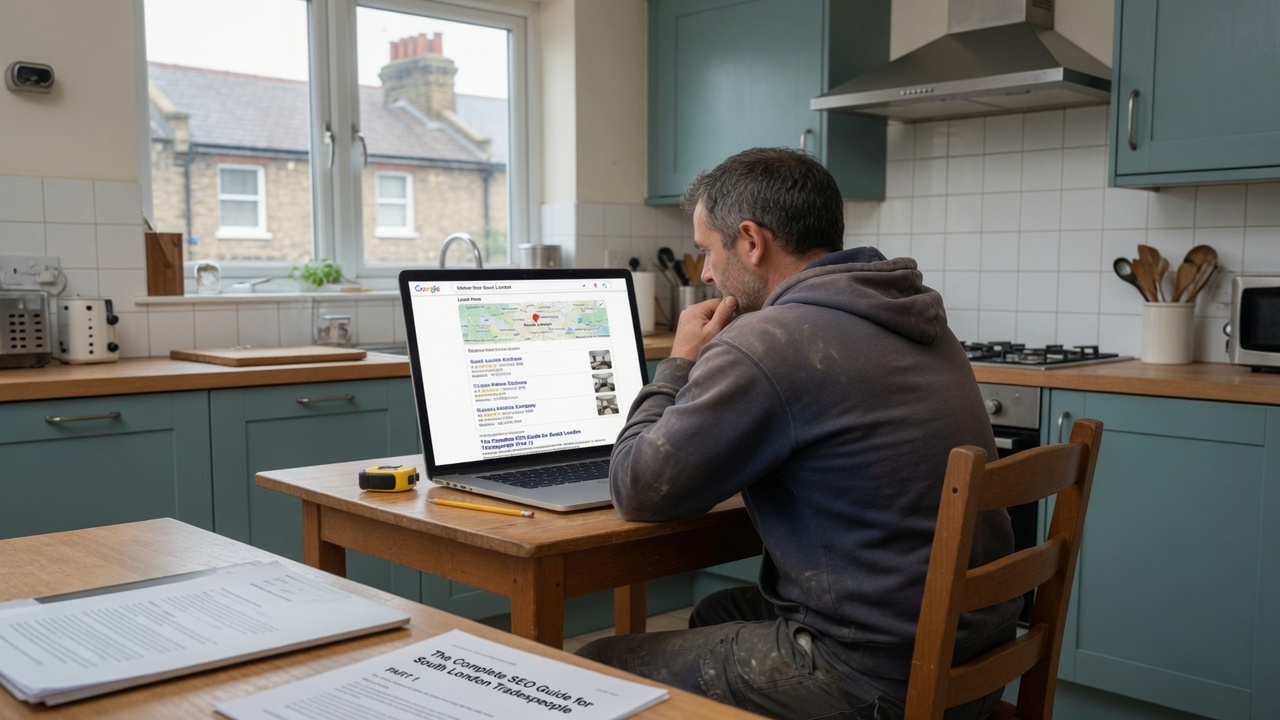
SEO is one of the most requested topics we get asked about by South London trades businesses. How does it actually work? What does it involve? And is it something you can realistically do yourself? We've gone into real depth to make sure you get everything you need — which is exactly why this is a two-parter. There's a lot to cover, and we'd rather give you the full picture than a surface-level summary.
If you've been running a trades business in South London for any length of time, you've probably heard the phrase "you need to sort your SEO." Maybe a client mentioned it. Maybe you've Googled your own business and noticed competitors showing up above you. Maybe you've been pitched by an agency promising page one results in 30 days.
SEO — Search Engine Optimisation — is one of the most powerful tools available to a local trades business. It's also one of the most misunderstood. Part 1 of this guide explains exactly what SEO is, how Google decides who to show, and the first four elements of a properly executed strategy. Part 2 covers the remaining elements, the honest time investment involved, and what it looks like to have it done properly for you.
What SEO actually means for a trades business
SEO is the process of making your business more visible in search engine results — specifically Google, which handles over 90% of all searches in the UK.
For a South London tradesperson, this breaks down into two distinct areas:
Local SEO — appearing in Google Maps and the Local Pack when someone nearby searches for your trade. "Kitchen fitter Clapham." "Builder South London." "Bathroom renovation Brixton." These are high-intent searches from people who are actively looking to hire someone. Showing up here is worth more than almost any other form of marketing.
Organic SEO — appearing in the regular search results below the map. This is where longer, more considered searches land. "How much does a kitchen extension cost in South London." "Best way to find a reliable builder in Clapham." People doing this kind of searching are in the research phase — not quite ready to hire, but building a shortlist.
Both matter. Local SEO drives immediate enquiries. Organic SEO builds long-term authority and trust.
How Google decides who to show
Google's job is to show the most relevant, trustworthy result for every search. To do that, it uses hundreds of ranking signals — but for local trades businesses, the most important ones are:
- Relevance — Does your website and Google Business Profile clearly communicate what you do and where you do it? A site that says "we offer quality services across London" is far less relevant than one that says "kitchen fitting in Clapham, Brixton and Dulwich."
- Proximity — How close is your business to the person searching? This is partly why claiming and completing your Google Business Profile with accurate address and service area information matters so much.
- Authority — Does Google trust your business? Trust is built through inbound links from other websites, consistent business information across the web, review volume and recency, and how long your website has been established.
- User experience — Does your website load quickly? Is it easy to navigate on a mobile phone? Does it give people the information they're looking for without making them hunt for it?
- Content quality — Does your website actually say something useful? Google has become increasingly sophisticated at recognising thin, generic content versus genuinely helpful, specific information.
Understanding these signals is the foundation of any serious SEO strategy. Improving them — systematically, over time — is what moves you up the rankings.
The complete SEO strategy for South London trades: what it actually involves
This is the part most people gloss over. SEO isn't a one-time fix. It's a sustained programme of work across multiple areas. Here's the first four — and an honest assessment of the time each one requires.
1. Technical SEO audit and fixes
Before anything else, a technical audit identifies the issues preventing Google from properly reading and ranking your website. This includes crawlability — can Google's bots access all your pages? Site speed — how quickly does each page load, especially on mobile? Indexation — are all your pages appearing in Google's index, or are some being accidentally excluded? Broken links — are there pages or links that lead nowhere? Schema markup — have you added the structured data that helps Google understand your content?
A thorough technical audit on a trades website typically takes 4–6 hours and produces a prioritised list of fixes. Implementing those fixes takes additional time depending on the complexity of the site. This is foundational work — nothing else performs properly until it's done.
2. Keyword research
Keyword research is the process of identifying exactly what your potential clients are typing into Google — and then building your content and optimisation strategy around those terms.
For a South London kitchen fitter, this might reveal that "kitchen fitter Clapham" gets 90 searches a month, "kitchen installation South London" gets 170, and "kitchen fitting cost South London" gets 320. Each of these represents a different type of searcher at a different stage of the buying journey — and each requires a different approach.
Proper keyword research uses specialist tools — Semrush, Ahrefs, Google Search Console — and typically takes 3–5 hours for a single trades business. It's not a one-time exercise either. Search behaviour evolves, and your keyword strategy needs to evolve with it.
3. Google Business Profile optimisation
Your Google Business Profile is the single most important local SEO asset you have. A fully optimised profile means:
- Complete and accurate business information including name, address, phone number, website and hours
- The correct primary and secondary categories selected
- A keyword-rich business description
- A minimum of 20 high-quality photos, updated regularly
- Services listed with descriptions
- Regular posts — at minimum fortnightly
- Active review management — requesting reviews, responding to every one
Setting up a GBP properly from scratch takes approximately 3–4 hours. Maintaining it — posts, photos, review responses — takes 2–3 hours per month ongoing. Most trades businesses set it up once and never touch it again. The ones showing up in the Local Pack are treating it as a living business asset.
4. On-page SEO
On-page SEO is the optimisation of your actual website pages. This includes:
Page titles and meta descriptions — the text that appears in Google search results. Every page needs a unique, keyword-rich title and description that accurately represents its content and encourages clicks.
Heading structure — your H1, H2 and H3 headings need to include relevant keywords and create a logical content hierarchy that both Google and human readers can follow.
Body copy — your page content needs to include the terms your potential clients are searching for, used naturally and in context. For a South London kitchen fitter, this means mentioning specific areas, specific services and specific contexts.
Internal linking — connecting your pages to each other in a logical structure helps Google understand the relationship between your content and distributes authority across your site.
Image optimisation — every image on your site should have a descriptive file name and alt text that includes relevant keywords.
Optimising a trades website with 8–10 pages takes approximately 8–12 hours. Maintaining and improving on-page optimisation as you add content is an ongoing process.
That's the foundation covered — and we're only halfway through.
Part 2 covers the remaining four elements of a complete SEO strategy — content, citations, link building and ongoing monitoring — plus an honest breakdown of exactly how many hours a properly executed SEO programme takes each month, and what it looks like when you hand all of it over to specialists who already know the South London market.
In the meantime, if you'd like to know exactly where your business stands on Google right now, visit our dedicated SEO page for South London trades businesses — or book a free 20-minute online presence audit and we'll tell you precisely what to fix first.
Find out exactly where you stand on Google.
Book a free 20-minute online presence audit — we'll review your Google listing, website and search rankings and tell you precisely what's costing you enquiries.