The New AI Marketing Stack Every Ambitious Business Needs in 2026
AI has moved from novelty to necessity. Here is the practical, integrated toolkit — strategy, content, personalisation and optimisation — that ambitious businesses are using in 2026 to move faster, waste less and build marketing systems that actually deliver predictable revenue.
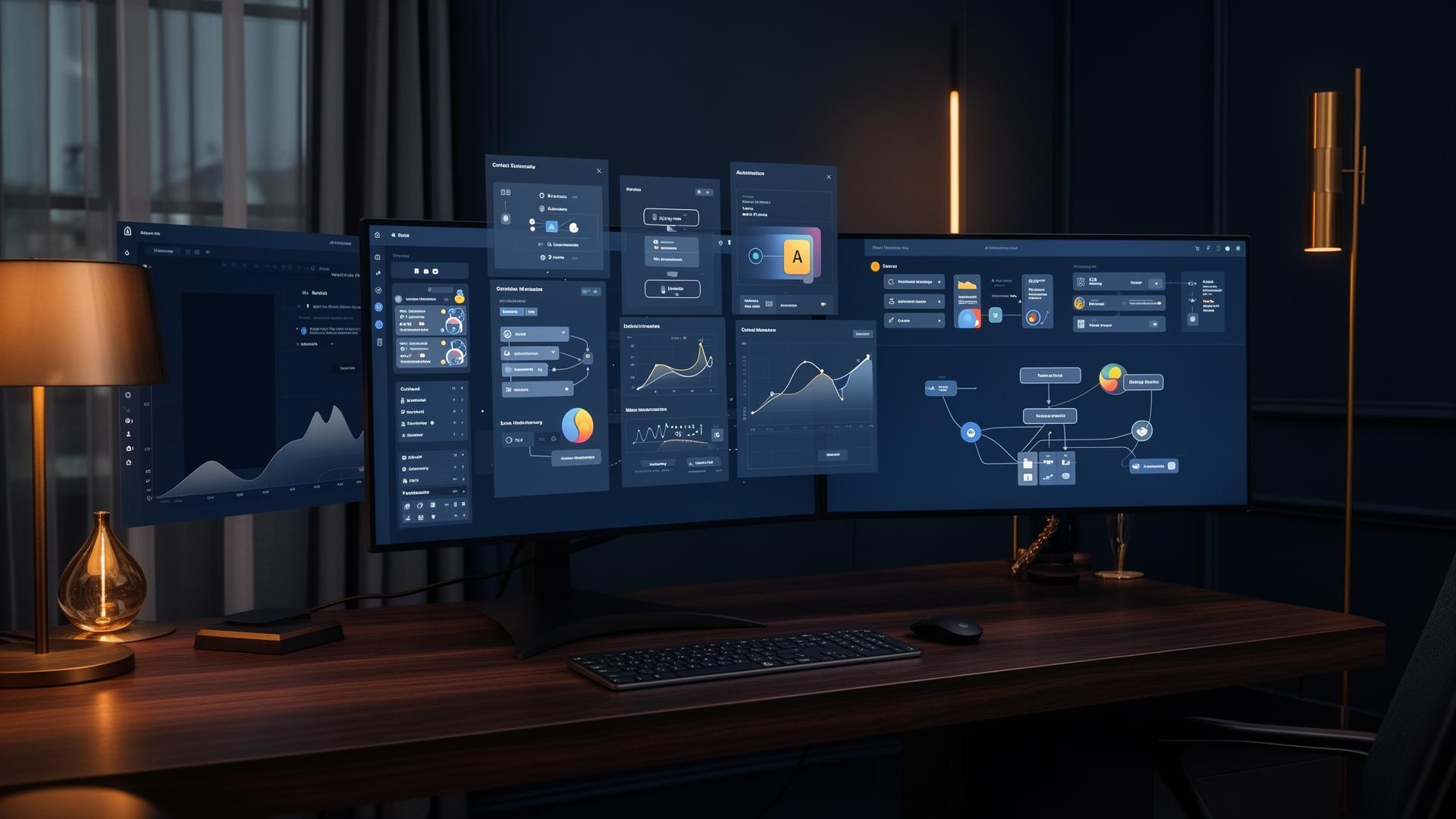
AI in marketing has crossed an invisible line. It is no longer a curiosity or a productivity hack. In 2026, it is the operating system behind every high-performing marketing function — from the way strategies are researched, to the way content is produced, to the way audiences are nurtured and campaigns are optimised. The businesses pulling away from their competitors are not the ones using the most AI tools. They are the ones using the right ones, in the right order, connected into a single stack that compounds.
This piece is the practical, senior-level breakdown of what that stack looks like today. We are not chasing hype. We are mapping the tools and workflows that genuinely move the needle — the ones OM Marketing uses with clients to build marketing systems that deliver predictable revenue. If you are an ambitious business leader who wants to cut through the noise and understand what actually works, this is for you.
One principle before we begin. AI is a co-pilot, not a replacement. It accelerates research, drafting, analysis and optimisation. It does not replace brand voice, strategic judgement, or the human relationship between your business and its customers. The businesses winning in 2026 are the ones that treat AI as a force multiplier for their best people — not a shortcut around them.
1. Strategy & Research: move from guessing to knowing
The quality of your marketing strategy in 2026 is determined less by gut instinct and more by the depth of your research — and the speed at which you can turn that research into a clear plan. AI has made it possible to compress what used to take weeks into hours, without sacrificing rigour.
For real-time market and competitor research, Perplexity has become the indispensable starting point. It searches the live web, synthesises multiple sources instantly, and gives you cited answers to complex strategic questions — from what your competitors are messaging right now, to how buyer behaviour is shifting in your sector, to which emerging trends are worth your attention this quarter. The key is not the answer itself; it is the 80% time saving that lets you spend your energy on judgement and decision-making instead of trawling search results.
For deeper strategic writing and positioning work, Claude remains the standout tool for long-form, nuanced thinking. Where some AI tools produce generic, templated output, Claude handles complexity — helping you articulate value propositions, refine messaging hierarchies, and stress-test strategic arguments in a way that still sounds like a human strategist wrote them. We use it at OM Marketing to accelerate the first draft of strategy documents, not to replace the senior thinking that shapes them.
The workflow here is simple but powerful. Use Perplexity to gather intelligence quickly and broadly. Use Claude to synthesise that intelligence into a coherent strategic position, brief or plan. Then have a senior strategist review, refine and own it. The output is faster, better-informed and more rigorous than either human-only or AI-only approaches.
2. Content Creation & SEO: quality at speed, without the shortcut look
Content is still the asset that pays you back forever — but the production model has changed. AI now handles the heavy lifting of research, structure, drafting and optimisation, while human editors shape voice, add original insight and ensure the final piece genuinely earns the reader's attention.
For writing and long-form content, Claude leads the field. It drafts articles, white papers, email sequences and landing page copy that reads like a senior writer produced it — provided you brief it with precision. The difference between mediocre AI content and excellent AI content is almost always the quality of the human input: a clear brief, a defined tone, a specific audience, and a sharp angle. Feed Claude a vague request and you get generic output. Feed it a rigorous brief and you get a strong first draft that a skilled editor can shape into something exceptional.
For SEO-optimised content that actually ranks, Surfer SEO and Clearscope are the tools that bridge the gap between great writing and search engine visibility. They analyse the top-ranking pages for any keyword, identify the topics, structure and semantic signals Google is rewarding, and guide your content to match — without making it read like a robot wrote it. Used properly, they ensure your best thinking also gets found.
For visual content, Canva's Magic Studio and Midjourney have transformed how quickly high-quality creative assets can be produced. Canva handles social graphics, presentations, carousels and web imagery at speed; Midjourney creates distinctive, on-brand visuals that would once have required a photographer or illustrator. Neither replaces a creative director — they replace the bottleneck of production, so your creative team can focus on concept and direction rather than execution.
The winning workflow in 2026 looks like this: research with Perplexity, brief with strategic clarity, draft with Claude, optimise for search with Surfer or Clearscope, produce visuals with Canva or Midjourney, and edit ruthlessly with a human who understands your brand voice. The result is content that is faster to produce, better structured for search, and still unmistakably yours.
3. Personalisation: the shift from broadcast to one-to-one at scale
Generic marketing is expensive. Personalised marketing is efficient. The difference in 2026 is that AI has made personalisation achievable for businesses of every size — not just the enterprise platforms with dedicated data teams.
For email marketing and lifecycle automation, Klaviyo remains the benchmark for e-commerce and D2C brands. Its AI-powered segmentation, predictive send-time optimisation and behavioural triggers mean your email programme gets smarter the more it runs — sending the right message to the right person at the right moment, automatically. For B2B and service businesses, HubSpot's AI features have closed the gap significantly — intelligently scoring leads, surfacing the most engaged contacts, and suggesting the next best action for your sales and marketing teams.
The real value is not the tool itself; it is the integration. When your email platform, CRM, website analytics and ad platforms share data, personalisation stops being a tactic and becomes a system. A visitor who reads three blog posts on pricing gets a different email sequence than one who reads case studies. A customer who browses a product category sees a different retargeting ad. A lead who clicks a nurture email gets a different homepage experience. This is where AI personalisation delivers its highest returns — not in isolated campaigns, but in connected experiences that make every buyer feel understood.
At OM Marketing, we see the businesses gaining the most from personalisation are the ones that invest in their data infrastructure first. Clean customer records, clear lifecycle stages, and unified tracking across touchpoints. AI amplifies the quality of your data; it does not fix bad data. Get the data right, and personalisation becomes a genuine competitive advantage.
4. Campaign Optimisation & Measurement: stop guessing, start compounding
The final pillar is where many businesses leak the most money. Campaigns are launched, budgets are spent, and performance is reviewed too late with metrics that do not tell the full story. AI in 2026 has made real-time optimisation not just possible but expected.
For paid media, the native AI inside Google Performance Max and Meta Advantage+ has reached a level of sophistication where manual bidding and audience targeting are increasingly obsolete — provided the algorithm is fed with high-quality creative, accurate conversion data and clear business objectives. Performance Max uses AI to find your best customers across all Google inventory, not just Search; Advantage+ automates creative combinations and audience targeting at a scale no human media buyer can match. The brands winning with these tools are not the ones micromanaging every setting. They are the ones feeding the algorithm excellence and letting it learn.
For analytics and attribution, the shift is from platform-reported numbers to owned measurement. Server-side tracking, first-party data collection and modelled conversions — all increasingly AI-assisted — give you a clearer picture of what is actually working than any single ad platform's dashboard. Google Analytics 4's predictive audiences, AI-powered insights and anomaly detection help you spot trends and problems faster. But the real unlock is building a unified measurement layer that aggregates data from every channel and judges performance by revenue and pipeline contribution, not vanity metrics.
The principle here is discipline. AI optimisation tools are powerful, but they optimise against whatever goal you set. Feed them the wrong goal — clicks instead of customers, impressions instead of revenue — and they will efficiently waste your money. Feed them the right goal, with accurate conversion data, and they compound your returns quarter after quarter.
The Recommended Starter Stack
If you are building or upgrading your AI marketing stack in 2026 and want a practical starting point without being overwhelmed, here is the lean, high-impact toolkit we recommend to most ambitious businesses:
- Strategy & Research: Perplexity for real-time research; Claude for strategic writing and positioning.
- Content & SEO: Claude for drafting; Surfer SEO or Clearscope for search optimisation; Canva Magic Studio for social and web visuals.
- Personalisation: Klaviyo for e-commerce / D2C email; HubSpot AI for B2B lifecycle and lead nurturing.
- Optimisation: Native AI in Google Performance Max and Meta Advantage+ for paid; GA4 with server-side tracking for measurement.
This is not an exhaustive list. It is a deliberately tight one. Start here, integrate these tools properly into a connected workflow, and measure what matters. Expand only when you have proven that the core stack is moving your key metrics. More tools do not mean better marketing. Better integration does.
The real advantage is integration, not innovation
The businesses quietly outperforming their competitors in 2026 are not the ones with the most AI tools. They are the ones with the most coherent stack — where research feeds strategy, strategy feeds content, content feeds personalisation, and personalisation feeds optimisation, all measured against the same commercial outcomes.
AI is the accelerant. Your strategy, your brand voice, your customer understanding and your commercial discipline are the engine. The businesses that confuse the two — treating AI as a substitute for thinking rather than a multiplier for it — will spend 2026 chasing trends and wondering why growth is patchy. The businesses that get it right will build marketing systems that compound into genuine competitive advantage.
At OM Marketing, we design, build and run exactly these systems for ambitious businesses — selecting the right tools, connecting them into a coherent workflow, and executing the strategy that turns them into predictable revenue. If you are ready to build an AI-powered marketing stack that actually works, book a discovery call below and let's design the right one for your business.
Build the AI-powered marketing stack your business actually needs.
Book a discovery call with OM Marketing and we'll design, build and run the integrated AI marketing system that delivers predictable revenue for your business.