
The South London Trades Business Owner's Guide to Google Analytics — Without the Jargon
You probably already have Google Analytics on your website and have never looked at it. Here's what it's actually telling you, what matters and what to ignore — in plain English.
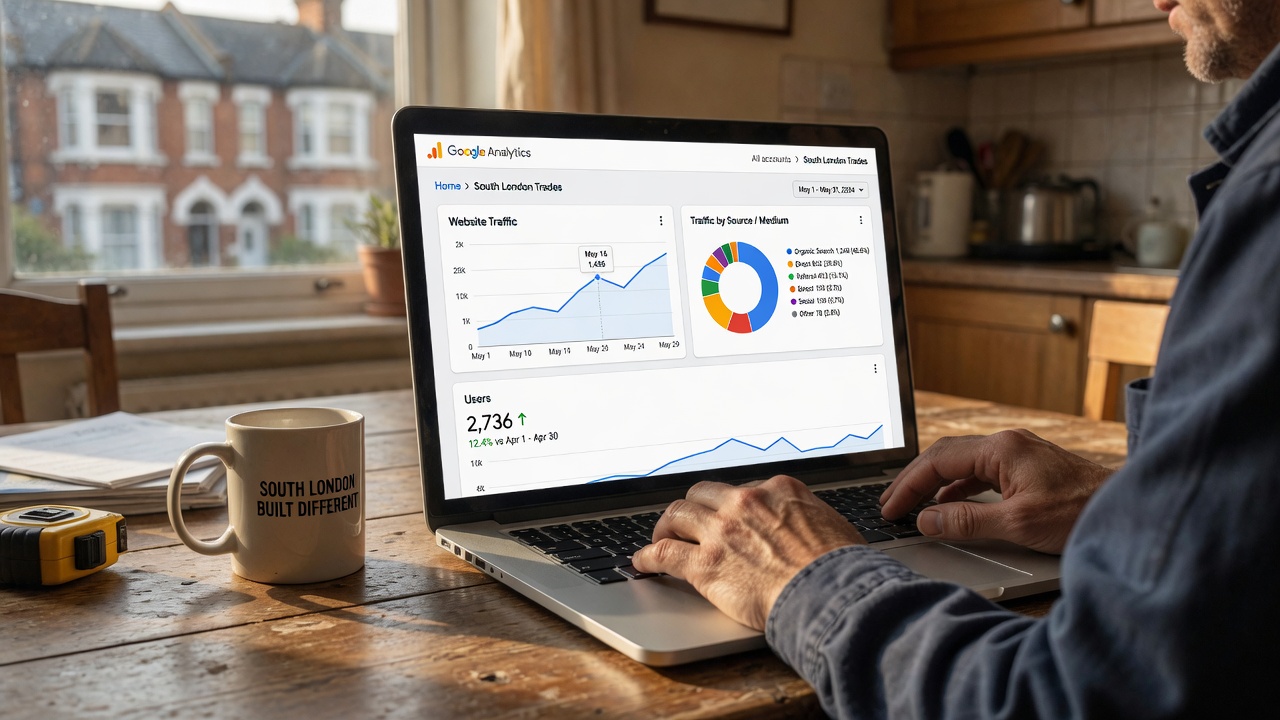
If your website was built in the last five years, there's a good chance it has Google Analytics installed. And there's an equally good chance you've never looked at it.
That's completely understandable — Google Analytics is one of those tools that looks intimidating the moment you open it. Graphs, metrics, dimensions, conversions — it can feel like it was designed for data scientists, not kitchen fitters.
But underneath all that, it's telling you something simple and incredibly valuable: who's visiting your website, where they came from, and whether they got in touch. Here's how to read it — without the jargon.
First: where to find what matters
When you log into Google Analytics (analytics.google.com), ignore most of what you see on the first screen. The four things worth checking regularly are:
- Users — how many people visited your website in a given period
- Sessions — how many visits (one person can visit multiple times)
- Traffic sources — where your visitors came from (Google, social media, direct etc.)
- Conversions — how many people completed a key action (form submission, phone call click)
Traffic sources — the most important number
For a South London trades business, the traffic source breakdown tells you which of your marketing efforts are actually working. Here's what to look for:
- Organic Search — visitors from Google search results. This is your SEO working. If this number is growing month on month, your rankings are improving
- Direct — visitors who typed your web address directly. Usually existing clients or people who saw your van or leaflet
- Referral — visitors from other websites linking to you. Good for understanding which directories or partners are sending traffic
- Social — visitors from Facebook, Instagram or LinkedIn. Tells you whether your social posts are driving people to your site
- Paid Search — visitors from Google Ads. If you're running ads, this shows how much traffic they're generating
What good looks like for a trades website
For a South London trades business doing SEO properly, you'd expect to see organic search as the largest traffic source — ideally 50–70% of total visits. If direct traffic is your biggest source, it suggests most of your visitors are people who already know you, rather than new potential clients finding you through Google.
Total monthly visitors for a local trades website can vary significantly — anywhere from 50 to 500+ depending on how established your online presence is. The number itself matters less than whether it's growing month on month.
The metric most trades businesses miss: conversions
Traffic without conversions is just noise. The most important question your analytics can answer is: of all the people who visited, how many got in touch?
To track this properly, you need conversion tracking set up — which means telling Google Analytics what counts as a successful action on your site. For a trades website, that's typically a contact form submission or a phone number click.
If you don't have conversion tracking set up, this is one of the first things we do for every OM Marketing client. Without it, you're flying blind on the most important metric your website produces.
How to use the data
Once you're looking at the right numbers, here's the simple monthly review we recommend for trades businesses:
- Are total visitors up or down vs last month? If down, why — did a ranking drop? Did you stop posting on social?
- Is organic search growing? If not, your SEO needs attention
- How many conversions did you get? What's the conversion rate (conversions divided by visitors)?
- Which pages get the most traffic? If your homepage gets visits but your contact page doesn't, people are landing and leaving without enquiring
When analytics becomes genuinely useful
The real value of Google Analytics isn't in the day-to-day numbers — it's in trends over time. After 3–6 months of consistent data, you can see clearly which marketing activities are driving real results and which aren't.
At OM Marketing, we include a plain-English monthly analytics report in every package. We pull the numbers, interpret them and tell you exactly what they mean for your business — so you never have to log into Google Analytics yourself unless you want to.
Not sure what your website data is telling you?
Book a free 20-minute online presence audit — we'll review your analytics alongside your Google listing and website and tell you exactly what's working and what isn't.